








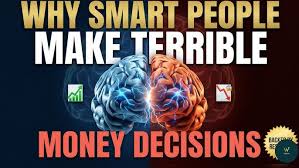
In the world of finance, we often operate under the «Rational Actor» myth—the belief that humans are logical, data-driven machines who, when presented with the right spreadsheet or investment strategy, will act in their own best interest. But as of 2026, after years of market volatility and technological disruption, the evidence is overwhelming: intelligence and financial success are not correlated. In fact, some of the most intellectually brilliant individuals—surgeons, engineers, and academics—are often the most prone to catastrophic financial ruin.
The reason is simple: Money is not a math problem; it is a psychological one. The hidden psychology of money reveals that our financial decisions are governed less by logic and more by the deep-seated biases, survival instincts, and social pressures we have carried since the dawn of the human species.
1. The «Ego-Complexity» Trap
Smart people often fall victim to the Ego-Complexity Trap. Because they have achieved high levels of success in their chosen fields, they assume their cognitive prowess is portable. They believe that if they can solve complex engineering problems or navigate intricate legal frameworks, the stock market is merely another puzzle to be cracked.
This leads to a fatal overconfidence. The smart investor views market volatility as a «problem» that can be solved with better data, faster algorithms, or more sophisticated models. However, the market is a Complex Adaptive System, not a static equation. In a complex system, the «smartest» action—like trying to out-think the market—is often the most dangerous. While the amateur looks for a «hack,» the elite allocator looks for a process that minimizes the need for genius.
2. The Influence of the «Social Mirror»
Financial decisions are rarely made in a vacuum; they are filtered through the Social Mirror. We are tribal creatures, and for most of human history, being cast out of the tribe meant death. Today, that survival mechanism manifests as the fear of being «left behind.»
- FOMO (Fear of Missing Out): When a neighbor or colleague makes a fortune on a speculative asset, our tribal brain screams that we are losing status.
- Social Proof: We assume that if everyone else is doing it—buying a specific tech stock or real estate in a certain bubble—it must be safe.
Smart people are often the most susceptible to this because they have spent their lives being «right» within their social circles. When their peers participate in a bubble, the social cost of not participating feels higher than the financial cost of losing money.
3. The «Experience Bubble» Bias
We are all products of our generation. A person who reached their prime investment years during the «Great Moderation» (low inflation, steady growth) perceives risk entirely differently than someone who came of age during a period of hyper-inflation or a global debt crisis.
Smart people often fail here because they rely on their «lived experience» as if it were a universal law. If you have only ever known a world where stocks always recover, you will have no psychological preparation for a «Lost Decade.» The tragedy is that the events that teach us the most about money are the ones that are least likely to repeat in the same way. The market rewards those who can detach their personal history from their current strategy.
4. Why We Prefer «Being Right» Over «Making Money»
One of the most profound psychological paradoxes is that many people would rather have their investment thesis proven correct than actually generate wealth.
If you take a strong public stance on a company or a macroeconomic trend, your brain begins to view the asset not as a tool for wealth, but as an extension of your own identity. When the data shifts, the smart person does not pivot; they double down. They defend their «original genius» long after the market has signaled a change. This is the Sunk Cost Fallacy elevated to an identity crisis. The 1% allocator understands that conviction is a liability if it prevents you from changing your mind.
5. The «Quietness» Requirement
The hidden psychology of money suggests that the best financial decisions are often the most boring—and therefore, the most psychologically difficult to sustain.
- Patience: Most people want to get rich fast, but the math of compounding only works slow. The human brain finds exponential growth counter-intuitive. We want to see results today.
- Humility: Admitting that you cannot predict the future is the most powerful financial skill, but it is the most insulting to an ego that prides itself on foresight.
6. How to Protect Yourself from Your Own Brain
If you are a high-achiever, you must actively insulate yourself from your own intelligence. Here is how the modern investor avoids the «Smart Person’s» pitfalls:
- Outsource the Emotion: If you know your brain is biased, don’t rely on it. Use pre-committed rebalancing rules, automated investments, and independent investment committees. Make the rules before the market starts moving.
- Separate Identity from Assets: Never link your self-worth to your portfolio performance. Treat your portfolio as a cold, inanimate business entity that you happen to manage. If the entity is losing money, you are not a failure; the strategy just needs an audit.
- Optimize for Survival, Not Just Growth: The smartest investors in history have been those who ensured they were still in the game after everyone else had been wiped out. As the saying goes, «To win, you must first survive.»
- Practice «Intellectual Falsification»: Instead of asking «Why is this a good investment?», force yourself to write down a detailed list of reasons why your current investment thesis might be completely wrong. This simple act of psychological distancing is the most effective antidote to confirmation bias.
Conclusion: The Ultimate Edge
The most dangerous financial decision-maker is the «Smart Person who thinks they have it all figured out.» The hidden psychology of money teaches us that the market is a great equalizer; it does not care about your IQ, your degrees, or your past accomplishments. It only rewards behavior.
The ultimate edge in 2026 is not found in higher complexity or faster processing. It is found in behavioral discipline. The people who make the most money are often those who can sit still, admit they don’t know what will happen next, and stick to a process that ignores the siren song of their own ego. By understanding that your brain is your greatest financial risk, you finally gain the perspective needed to stop playing a game of «genius» and start playing the game of «wealth.»
Disclaimer: This analysis is for educational purposes and explores behavioral finance. It is not personal financial advice. All investment strategies carry risks; consider your personal financial goals and consult a qualified advisor.