








Here is the comprehensive article you requested, starting with the optimized keywords for SEO and high-paying CPM (Cost Per Mille) advertising networks.
Target Keywords for SEO & High CPM
Primary High CPM Keywords (Finance & Tech Niches):
- Artificial intelligence wealth management
- Automated trading software algorithms
- Best AI stock trading platforms
- Quantitative hedge fund strategies
- Machine learning portfolio optimization
- Robo-advisors for institutional investors
Core SEO Keywords:
- AI vs human investors
- AI investing
- Artificial intelligence in finance
- Algorithmic trading
- Can AI predict the stock market
- Machine learning in trading
Long-Tail SEO Keywords:
- How artificial intelligence is changing the stock market
- Will AI replace human financial advisors
- Comparing human intuition vs AI data analysis in investing
- The impact of machine learning on hedge fund performance
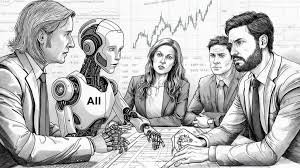
Can AI Beat Human Investors?
Introduction: The New Wall Street Battleground
For decades, the financial markets have been a battleground of human intellect, intuition, and nerve. From the bustling, chaotic trading floors of the New York Stock Exchange to the quiet, analytical boardrooms of massive hedge funds, human beings have historically dictated the flow of global capital. However, the landscape of investing is undergoing a seismic shift. The rapid advancement of Artificial Intelligence (AI) and Machine Learning (ML) has introduced a new, formidable player to the market—one that doesn’t sleep, doesn’t panic, and can process information at a scale incomprehensible to the human brain.
The question echoing through Wall Street and retail investment communities alike is profound: Can AI truly beat human investors?
To answer this question, we must look beyond the science fiction tropes and examine the actual capabilities of modern financial AI. We must dissect the inherent weaknesses of human psychology in trading, the current limitations of algorithmic models, and the emerging strategies that are defining the future of wealth generation. The truth is far more nuanced than a simple «yes» or «no,» resting instead on the intersection of raw computational power and uniquely human adaptability.
The Evolution of Algorithmic Trading
To understand the current state of AI in investing, it is crucial to distinguish between traditional algorithmic trading and true artificial intelligence. Algorithmic trading, which has been present in the markets since the late 20th century, relies on pre-programmed rules. A human sets the parameters—for example, «buy Stock X if its 50-day moving average crosses above its 200-day moving average»—and the computer executes the trade. While incredibly fast, these systems are fundamentally rigid. They only know what they have been explicitly taught.
Modern AI, particularly deep learning and neural networks, operates differently. Instead of following static rules, AI models are fed massive datasets and tasked with finding correlations, patterns, and predictive signals on their own. They learn, adapt, and evolve. If a previously reliable market signal stops working, an advanced machine learning model can theoretically recognize the shift and adjust its strategy without human intervention. This dynamic adaptability is what gives AI the potential to outmaneuver traditional human analysis.
The Unmatched Strengths of Artificial Intelligence
When comparing a silicon chip to the human brain in the context of financial markets, AI possesses several overwhelming advantages.
1. Infinite Data Processing and «Alternative Data»
A human analyst can read a few annual reports, analyze a handful of balance sheets, and listen to a few earnings calls in a day. An AI system can process the financial statements of every publicly traded company on Earth in seconds. Furthermore, AI excels at ingesting «alternative data.» Today’s AI models analyze satellite imagery of retail parking lots to predict quarterly sales, scrape millions of social media posts to gauge consumer sentiment, and even track the flight paths of corporate private jets to anticipate mergers and acquisitions. This ability to synthesize disparate data points gives AI an informational edge that no human team could ever match.
2. The Elimination of Emotion
Perhaps the greatest downfall of the retail and institutional investor alike is emotion. Human beings are biologically hardwired with cognitive biases. We suffer from «loss aversion,» holding onto losing stocks too long hoping they will bounce back. We succumb to FOMO (Fear Of Missing Out), buying into assets at their absolute peak during a speculative bubble. AI does not feel fear, greed, panic, or euphoria. It executes its strategy with cold, calculated precision based entirely on statistical probability. During a market crash, when human traders are panic-selling, an AI will calmly execute its programming, often finding lucrative opportunities in the chaos.
3. Unfathomable Speed
In High-Frequency Trading (HFT), milliseconds can mean the difference between a massive profit and a complete loss. AI algorithms are co-located in servers right next to market exchanges, allowing them to execute thousands of complex trades in the blink of an eye. They can identify microscopic price discrepancies between different exchanges (arbitrage) and capitalize on them before a human trader has even blinked.
The Indispensable Human Element
If AI is faster, emotionless, and capable of processing infinitely more data, it might seem like the era of the human investor is definitively over. However, human beings possess distinct advantages that AI, in its current state, cannot replicate.
1. Contextual Nuance and Qualitative Analysis
Investing is not just about numbers on a spreadsheet; it is fundamentally about understanding people, businesses, and the world. AI struggles profoundly with context. When a CEO gives an earnings presentation, an AI can process the transcript and analyze the text for positive or negative keywords. But a human analyst can hear the hesitation in the CEO’s voice, note their defensive body language when answering a specific question, and understand the subtle geopolitical subtext of their statements. Human investors excel at qualitative analysis—judging the vision of a founder, the strength of a corporate culture, and the potential of a truly disruptive, unprecedented product.
2. Navigating «Black Swan» Events
AI models are trained on historical data. They learn how markets behaved in the past to predict how they will behave in the future. But what happens when an event occurs that has no historical precedent? These are known as «Black Swan» events. The outbreak of the COVID-19 pandemic in early 2020 is a prime example. The world simply shut down—an event absent from the training data of financial algorithms. During the initial weeks of the pandemic, many quantitative hedge funds suffered catastrophic losses because their models broke down under unprecedented conditions. Human investors, on the other hand, can reason through novel situations, apply common sense, and pivot their strategies based on entirely new paradigms.
3. Long-Term Vision and Value Investing
Most financial AI is optimized for short-to-medium-term trading. It looks for statistical anomalies that will play out over days, weeks, or months. However, some of the greatest fortunes in history—such as that of Warren Buffett—were built on decades-long value investing. This requires looking at a company, understanding its intrinsic value, and holding onto it for twenty years despite short-term market volatility. AI struggles to model twenty-year macroeconomic cycles and societal shifts because the variables over that time horizon are too chaotic and unpredictable for standard statistical modeling.
AI in Practice: How is it Performing Today?
When we look at real-world performance, the results are mixed but highly promising. Purely AI-driven ETFs (Exchange Traded Funds), such as the AI Powered Equity ETF (AIEQ), have shown periods of outperforming the broader market, but they have also experienced periods of significant underperformance. They have not proven to be a magic bullet for guaranteed, endless wealth.
However, in the world of elite quantitative hedge funds, AI is already dominant. Firms like Renaissance Technologies and Two Sigma have used complex mathematical models and machine learning to generate returns that consistently beat traditional, human-managed funds. Yet, it is vital to note that these firms do not let the AI run wild. They employ hundreds of human PhDs—physicists, mathematicians, and computer scientists—to constantly tweak, monitor, and update the algorithms.
The Rise of the «Centaur» Investor
So, can AI beat human investors? If we frame it as a head-to-head battle where a purely autonomous AI competes against a purely traditional human stock picker, the AI will likely win in short-term trading, while the human may still hold the edge in long-term, qualitative value investing.
But the future of investing is not a zero-sum game between man and machine. The true winner of the financial future is the «Centaur.»
In chess, after IBM’s Deep Blue defeated Garry Kasparov, a new style of play emerged called «Centaur Chess,» where a human player teams up with an AI. These Centaur teams consistently defeat both the best solo humans and the best solo computers. The same principle applies to investing.
The most successful investors of the future will be those who harness the power of AI to do the heavy lifting—scanning global data sets, running complex risk simulations, and monitoring real-time sentiment—while reserving the final decision-making, contextual reasoning, and strategic vision for the human mind. The AI acts as an infinitely capable exoskeleton for the human investor.
Conclusion
Artificial intelligence is undeniably transforming the financial markets. Its ability to process vast quantities of alternative data, execute trades with lightning speed, and eliminate emotional bias makes it an incredibly powerful tool. It has already beaten human investors in specific domains like high-frequency trading and statistical arbitrage.
However, the chaotic, unpredictable, and inherently human nature of the global economy ensures that pure algorithms cannot completely replace human intuition, ethical judgment, and contextual understanding. AI will not necessarily beat human investors across the board; rather, human investors who actively use AI will overwhelmingly beat human investors who do not. The future of Wall Street belongs not to the machine alone, but to the seamless integration of artificial intelligence and human ingenuity.