








The Tokenization of Real-World Assets (RWA): How Fractional Ownership Is Rewriting Global Liquidity
Introduction: The Great Financial Bridge
For centuries, the world’s most valuable assets—prime real estate, corporate debt, fine art, and infrastructure projects—were trapped behind a wall of high entry costs, legal complexity, and administrative inertia. They were inherently «illiquid,» meaning they could not be easily converted into cash without significant time, friction, and expense.
In 2026, we are witnessing the collapse of that wall. The Tokenization of Real-World Assets (RWA) has emerged as the most significant evolution in financial infrastructure since the digital ledger. By creating digital representations of physical or traditional assets on a blockchain, we are not just digitizing records; we are rewriting the fundamental laws of global liquidity. What once took months of paperwork and million-dollar buy-ins now happens in seconds, via fractional ownership, on-chain.
1. Defining RWA Tokenization: Beyond the Digital Facade
At its core, RWA tokenization is the process of mapping the legal rights of an off-chain asset (a building, a government bond, or a bar of gold) to a digital token on a distributed ledger. This isn’t a speculative digital collectible; it is a legally binding financial instrument.
When an asset is tokenized, a special purpose vehicle (SPV) or trust is typically created to hold the physical title. The blockchain token then represents an interest in that vehicle. This provides investors with verifiable, immutable proof of ownership. As of May 2026, the on-chain value of these tokenized assets has surpassed $31 billion, with categories ranging from US Treasuries to private credit and real estate.
2. The Power of Fractionalization: Democratizing the «Exclusives»
The «magic» of tokenization lies in fractionalization. Traditionally, if you wanted to invest in a $10 million commercial logistics center, you needed millions in capital and a seat at a private equity table.
With tokenization, that asset can be divided into 10,000, or even 1,000,000, individual tokens. This allows:
- Retail Accessibility: An investor with $1,000 can now own a piece of high-value commercial real estate, earning pro-rata rental yields just like an institutional landlord.
- Portfolio Diversification: Instead of putting all their capital into one volatile stock, an investor can spread their wealth across a basket of tokenized assets—gold, bonds, and property—all held in a single crypto wallet.
- Liquidity Transformation: Because these fractions are tradeable on digital secondary markets, assets that used to take months to sell can now be liquidated in minutes.
3. The 2026 Landscape: Where the Capital is Flowing
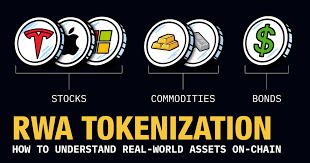
As of mid-2026, the RWA market has matured from speculative experimentation to institutional reality. The ecosystem is dominated by a few key asset classes:
A. Tokenized US Treasuries (~$12.88 Billion)
These represent the most «institutional» use case. By tokenizing short-term government debt, platforms like BlackRock and Franklin Templeton (with their BENJI token) have allowed on-chain capital to earn risk-free yields without leaving the blockchain ecosystem. This provides a «stable» bedrock for DeFi protocols.
B. Private Credit (~$5 Billion)
Small and medium-sized enterprises (SMEs) are using blockchain to access global capital pools. Instead of relying on slow, local bank loans, they can borrow from a worldwide network of digital investors, who in turn receive consistent yields backed by real business revenue.
C. Commodities (Gold)
Tokens like PAXG and Tether’s XAUt have set the standard for gold-backed assets. Each token is physically backed by allocated gold in secure vaults, providing the security of precious metals with the transaction speed of a digital token.
D. Tokenized Equities and ETFs
Platforms such as Backed Finance are leading the way in wrapping traditional stocks and ETFs into tokens. This allows crypto-native traders to pivot between Bitcoin and, for example, a tokenized version of an S&P 500 ETF without ever leaving the «on-chain» environment, avoiding the T+2 settlement delays of traditional finance.
4. How It Rewrites Global Liquidity
Liquidity is the lifeblood of any market. When an asset is illiquid, it is undervalued because of the «liquidity discount»—the price reduction required to tempt a buyer to take on an asset that is hard to sell.
Tokenization eliminates this discount through:
- 24/7 Global Trading: Unlike stock exchanges that close at 4:00 PM, blockchain markets never sleep. A tokenized property in London can be traded by a buyer in Tokyo at 3:00 AM.
- Instant Settlement: Atomic settlement (where ownership and payment happen simultaneously) removes the need for clearinghouses, banks, and lengthy settlement cycles, freeing up billions in capital that is usually «stuck» in transit.
- Composability: Tokenized assets act as «Lego bricks» for the Decentralized Finance (DeFi) ecosystem. An investor can take a tokenized treasury bond and use it as collateral to borrow stablecoins, creating a layer of financial efficiency previously impossible in TradFi (Traditional Finance).
5. The Structural and Regulatory Challenges
Despite the potential, 2026 is a year of «proof and friction.» The transition is not without hurdles:
- Legal Enforceability: A blockchain record is only as strong as the legal framework that backs it. If a dispute arises over the ownership of a building, the courts must recognize the token as the legitimate title. This is why many successful RWA projects are now «permissioned,» meaning participants must pass KYC (Know Your Customer) and AML (Anti-Money Laundering) checks to trade.
- Custodial Risk: If you tokenize a physical asset, you must have a trusted custodian. If the custodian holding the physical gold or the building title disappears, the digital token loses its backing. Verifying «Proof of Reserves» has become a mandatory industry standard for any legitimate RWA project.
- Regulatory Fragmentedness: While the EU’s MiCA regulation has provided some clarity, the global landscape remains patchy. Investors must still navigate the jurisdictional limitations of the assets they own, as tokens representing real estate in Spain cannot always be traded as freely as a decentralized crypto token.
6. The Road Ahead: 2026 and Beyond
We are currently in the «Proof of Infrastructure» phase. In 2024 and 2025, the focus was on building the rails. In 2026, the focus has shifted to institutional adoption and utility.
The next frontier is the integration of these RWAs into everyday financial products. Imagine a world where your savings account isn’t just a number in a bank database, but a dynamic portfolio of tokenized bonds, property, and equities that you can see, audit, and trade via a simple app.
The Verdict
The tokenization of real-world assets is not just another «crypto trend.» It is the inevitable digitization of the global economy. By fractionalizing ownership and moving assets onto liquid, programmable ledgers, we are lowering the barrier to wealth creation and bringing transparency to opaque markets.
For the investor of 2026, the choice is no longer between «safe» traditional assets and «volatile» digital assets. We are entering a hybrid era where the stability of physical assets and the efficiency of digital technology converge. Those who understand how to navigate this new landscape—leveraging fractional ownership to build truly diversified portfolios—will be the primary beneficiaries of this massive wealth migration.
Strategic Checklist for the RWA Investor:
Prioritize Compliance: Stick to projects that operate within regulated «sandboxes» or have clear licenses (like MiCA in Europe) to ensure your ownership is legally defensible.
Verify the Underlying: Does the issuer provide transparent, third-party audits of the underlying physical assets?
Understand the Legal Wrap: Is the token a security under your local law? Does it offer clear redemption rights if the issuer fails?
Check Liquidity: Even if it is a token, is there an active market, or are you locked in until maturity?